
Peak Performance Is a Trap
A while ago, iodyne invited us onto an episode of their Workflow Kitchen. On paper, the topic was simple: storage performance. The conversation didn't stay there. Within minutes, we were talking about how workflows behave under real pressure, and why predictability matters more than raw speed.
Speed you can sustain
Much of the industry still talks about performance in peak numbers. Maximum throughput. Best-case scenarios. That's not how workflows actually run. As iodyne put it, what matters isn't how fast something can go. It's how fast it can run consistently, and for how long. In production, you're not counting seconds. You're moving terabytes, planning hours, and relying on timing to line up across a dozen steps.
That's where sustained performance becomes critical. If a job is supposed to take 25 minutes, it needs to take 25 minutes, not 40. The moment that expectation slips, everything downstream slips with it.
This is where workflows often go wrong. Performance gets quoted in megabytes per second. That's fine for benchmarking, but useless for planning. It's an IT metric, and it doesn't reflect how people actually work.
The number that means something is simpler: how much data can I move in an hour? If you know one drive is a terabyte per hour slower, you understand the cost right away. You can decide whether to use it, explain the trade-off to a producer, and adjust before it becomes a problem. Abstract speed turns into real time, and the process gets clear again.
Most workflow trouble is preventable
Across our apps, the same pattern shows up: most problems aren't dramatic failures. They're things that could have been headed off earlier. Drives with different performance characteristics. Media handled inconsistently. Workflows that technically work but aren't predictable. Rather than getting good at fixing problems after the fact, we'd rather they never happen. That's where guardrails come in.
In practice, that means not exposing every possible option. Often we deliberately remove the ones likely to cause trouble down the line. The idea is simple: if a workflow is predictable, you don't have to think about it constantly.
It's also why each of our apps stays focused on one part of the job. Backups, reports, transcoding, collaboration, archive: each has its own requirements. Cram all of it into a single tool and you add complexity, not clarity. Keep them separate, and you can pick what a production needs and leave the rest out of the way.
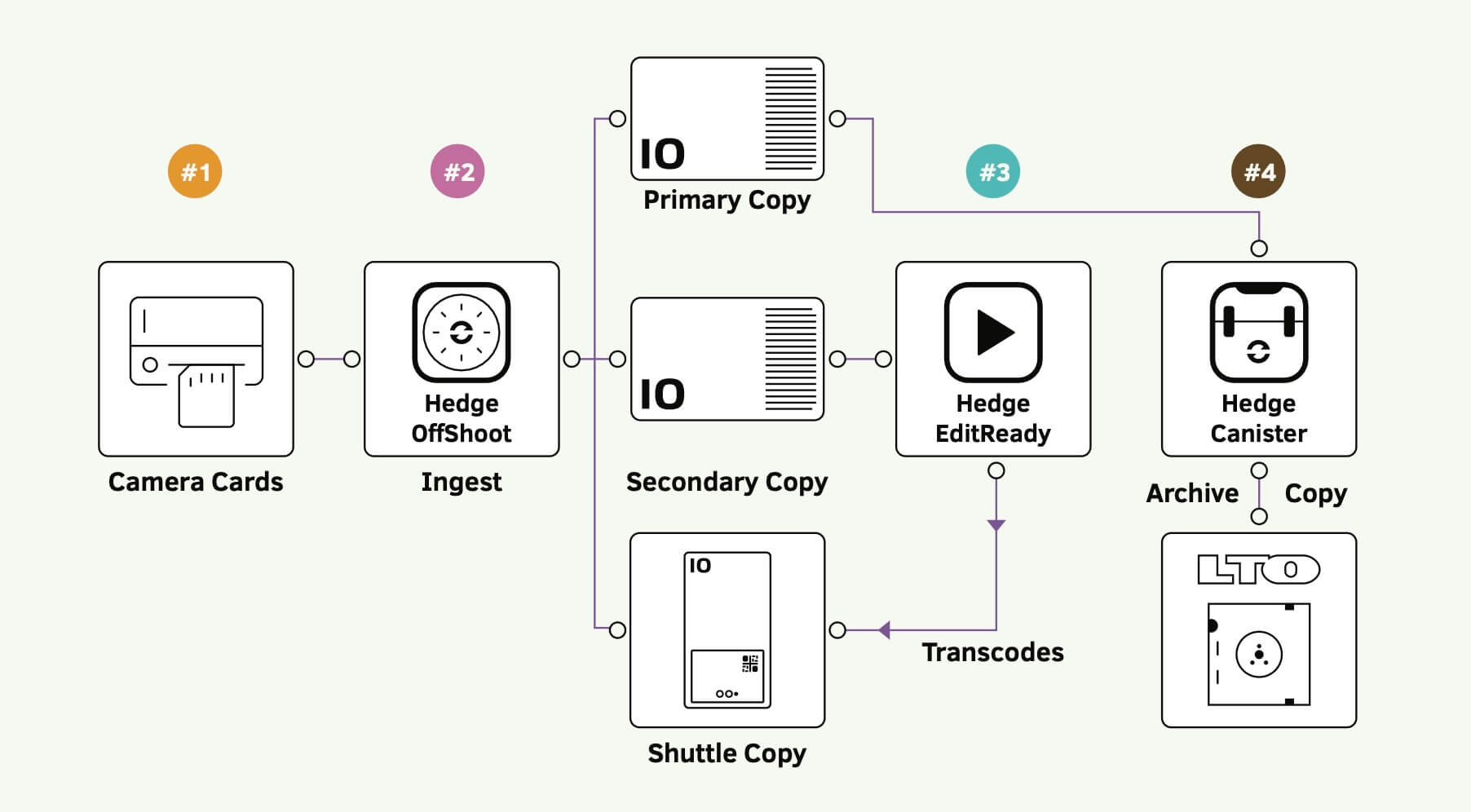
Here's how this looks when supercharging Hedge apps with iodyne:
Watch the full Workflow Kitchen conversation here:
From ingest to archive, every step depends on the one before it behaving as expected. That's where hardware and software meet. Storage delivers sustained speed; software turns it into clarity and control. Predictability is what keeps a workflow afloat. Not in ideal conditions, but when things get messy and time-critical.