
ARRI Academy: from camera to delivery
A solid workflow doesn't start on set. It starts at the end, with knowing what you have to deliver. That's the philosophy behind ARRI Academy, ARRI's in-house training program, and it runs through everything they teach. From how to operate a camera system to how to make sure every bit of footage arrives safely at its destination.
We sat down with senior trainer Florian Rettich to talk about filmmakers and data, how the Academy works, and why everything that you do before you press record matters the most.
ARRI Academy
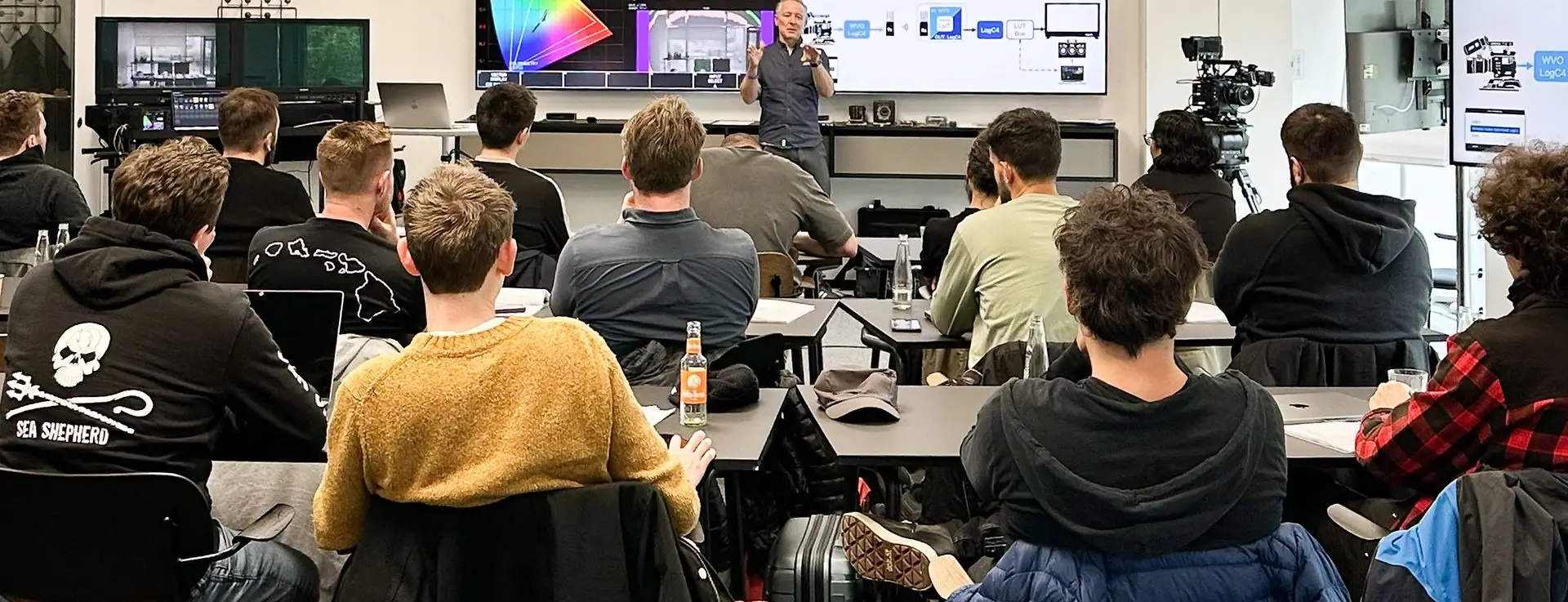
Florian: "The Academy is a training program within ARRI. The core team is sitting in the headquarters here in Munich. We have trainers in different regions, so we try to have classes available in at least some languages. Either by traveling to different locations or by certifying local trainers to host our classes.
The goal is to reach a relatively wide range of people. So we start with film students, people who want to get into the industry, owner-operators who just want to go the next step, and working professionals from all kinds of the film industry. We have been doing that for 10 years now."
The Academy draws from a broad mix of backgrounds and experience levels. While there's no formal selection process, most classes work best when participants bring at least some foundation with them. The curriculum reflects this: it's built not just around how to operate the ARRI camera system, but around understanding why it works the way it does.
"We focus a lot on production requirements because my philosophy is to try to work from the end to the beginning. A reverse strategy. Only if you know where to go do you know how to set the camera in the first place. This does, of course, cover many topics."
Beyond the camera classes, the Academy trains instructors and certifies students at universities across Europe, Asia, and Australia, in a program called ARRI Certified Film Schools.
"The benchmark is consistent: a student who holds that certificate knows how to work with an ARRI camera."
Data workflows
Data management is one of those areas where the gap between knowing and doing can cost a production dearly. At ARRI Academy, it's also one of the areas where participants arrive with the widest range of assumptions.
"Data verification is a tough one because it really depends on where people are coming from. We still have people asking: 'Why do I need checksumming?' So it starts with making them understand certain strategies.
It also happens that everybody understands how proper data management works, but cuts corners in other aspects. For instance, when learning about ARRI specialties, let's say in the color pipeline.
A creative person there always looks at or talks in images: 'How can I achieve a look? I heard this here and there, and how is it really?' That's not where it starts. It begins with what is coming from the image processing. The final result is down the line.
Sometimes I have to stop some dreams radically and say: 'No, you're riding the wrong horse. Turn around, try it out yourself, and get a feeling for, let's say, anamorphic squeeze factors.' This is also where the fun happens for me, as the instructor, that it is an interactive thing.
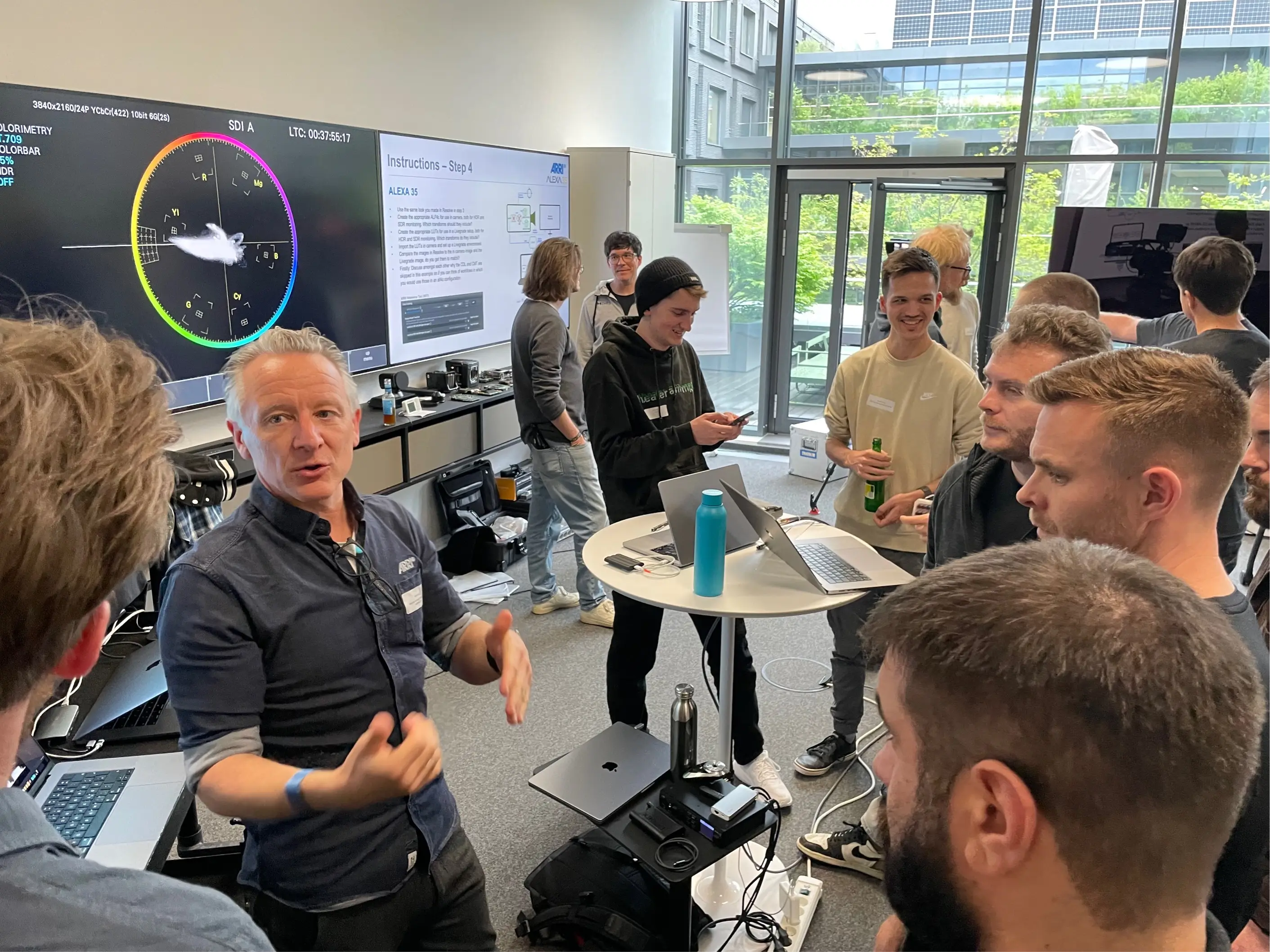
We have certain sessions that are pre-compiled, modules that we're trying to cover, but in a nutshell, not every training is exactly the same, because we try to adapt it a little bit to the participants."
The core philosophy Florian teaches around workflow is straightforward, if counterintuitive: start at the end. Know your deliverable before you decide anything else. Only then can you make the right decisions at the camera end: what format to shoot, how to structure your offload, and how to set up your pipeline.
"Start with Z at the end, and try to find as many letters in the alphabet in between to make a good decision on A. This is how it starts for me. You need to know where to travel before you book a ticket.
It sounds a lot easier in theory than in reality because many shows don't know where to go and start shooting. But if you have this as a principle, you start with Z when possible. If not, start with U or maybe even with a K, and try to work back to A or B.
Being a professional or not is not necessarily defined by tools or by the camera. You can have an ARRI camera and still work in an unprofessional environment. It's a philosophy, and it's usually a structure.
The next phrase I usually tell them is 'fix it in prep' because that's the cheapest fix you can get. If you know your workflow and it works for a certain year or a specific project, then it's a good workflow. There is no right or wrong in workflows to me as long as you think it through.
The scary part to me is not knowing what you're doing and just saying: 'Okay, it's good enough. Here's the disk, it's not my problem anymore.' This is where the biggest trouble happens: ignoring the next steps, ignoring the people involved in the pipeline, et cetera.
Most people in this industry learned by pain, like me. My whole experience is based on 'I made a mistake.' And that's okay, as long as you make the mistakes when they're not super critical.
It happens to everybody: you offload to a drive, or you think you've offloaded to the drive, and you didn't verify at all. Turns out it wasn't the right drive, or it was disconnected during the ride. There are all sorts of things that can happen. And the only thing that helps is to try to establish a strategy. Even if you're shooting in a remote location and you need to work with minimal tool sets, it's your attitude that makes you a professional."
Digital, then and now
Ten years ago, shooting digitally was a different beast.
"In the beginning, everything about shooting digitally at a certain level was relatively painful and slow. Those were the long nights staring at blinking, slow-spinning disks and progress bars. So speed has increased faster than the requirements, the algorithms perform better, and the safety net has improved a lot.
A lot of things can be optimized to avoid certain manual steps that we used to do one after another. Your tools can do two things at once, or even three things, or you can hand over to another tool, share a database, or use cloud-based workflows. Of course, that makes things easier.
At some point, there is a complexity involved, but that is usually not driven by the technology; it's driven by the project requirements these days, because the complexity of productions has increased, too."
One thing, however, hasn't changed: the lack of prep time. Regardless of whether you're a Hollywood production or a one-person crew, the fight for proper preparation is universal. In comes data verification.
"How can you sleep at night if you are in charge of making sure your camera original is cloned to at least two destinations? The answer is verification, or checksumming, or whatever you want to call it."
"Losing footage on a bigger show means you're fired. I mean, literally tomorrow. Say you need to finish a movie, but you're lacking two days of shooting, and there's no budget for a reshoot.
ASC MHL finally sets a standard file format, which, for me, for a decade or even two decades, has been the problem of the industry. The checksum, which by definition is just that hash key, was sometimes just too complicated to read. And now with ASC MHL, you can verify a copy seven generations down all the way back to the first offload.
And that is the key to the whole story. You can still verify it back to this initial hash key. Hashing itself is not sexy. Sexy is, if you have a report that says green lights, all the clips are down, all the shooting days are safe. Minutes or gigabytes or whatever you translate this to, you just wanna get this thumbs up and then take a rest."
Join the raffle
Want to hear more of this from Florian himself? Until November 30th, we're raffling off one spot in ARRI's online Certified User Training for ALEXA 35. Whether you're a DOP, DIT, or CA, put your name in the hat.
Here's how to join: enter the raffle here.


